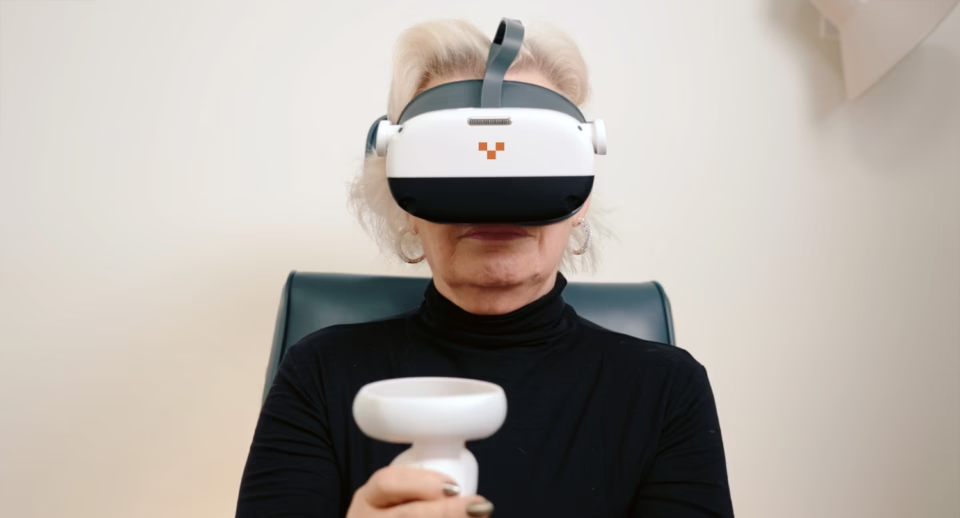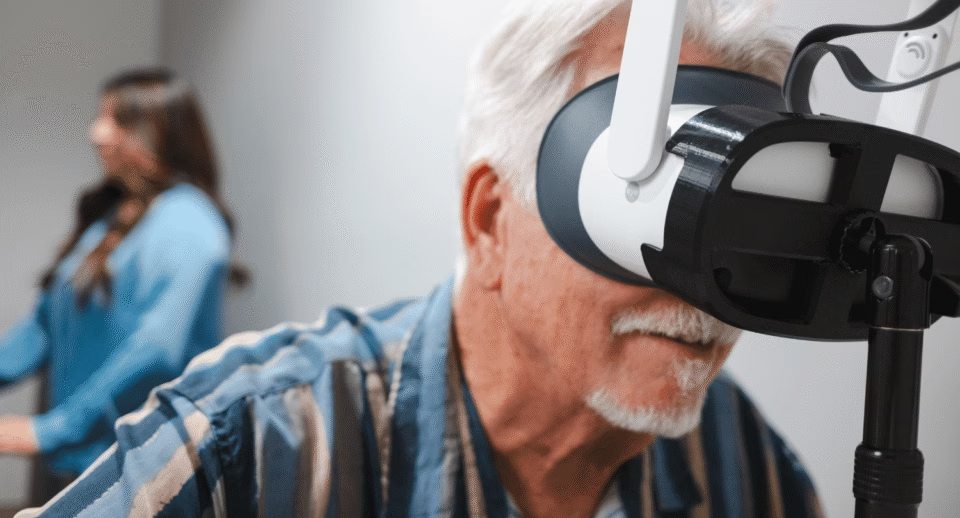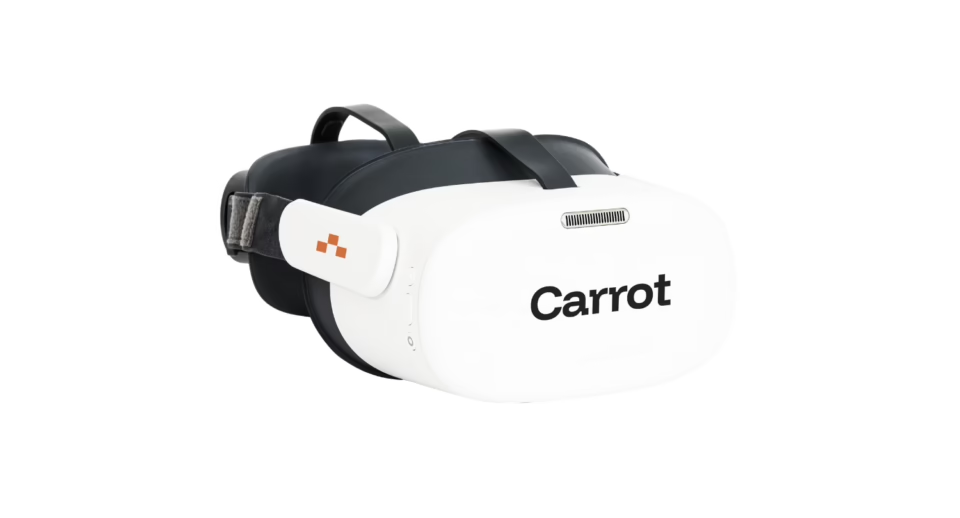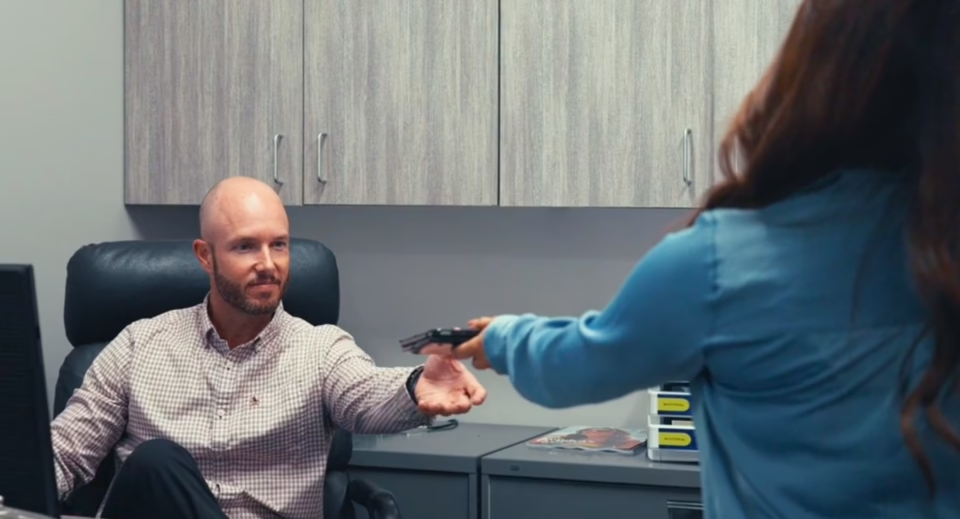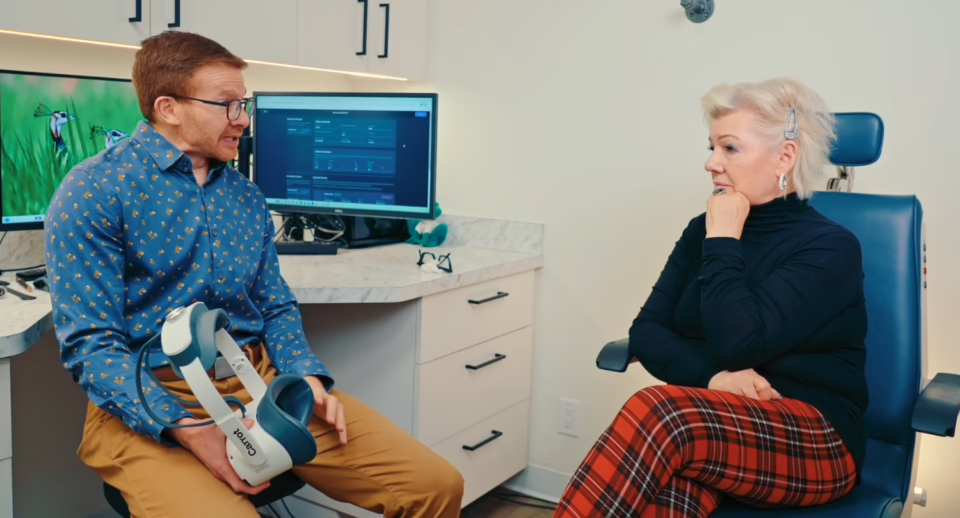
Introduction: Why Visual Field Testing Needs to Evolve
Whether you run a single-location practice or oversee care across a larger system, every part of your clinic shapes how patients experience your care. That includes your staff, your workflows, your space, and the technology you rely on every day.
Patient expectations have changed. Patients expect efficient visits, clear communication, and access to modern tools that support their care. They also expect the equipment used in their exams to reflect the same level of quality and consistency.
Visual field testing is no exception. In many practices, it still relies on workflows built around fixed equipment, dedicated rooms, and time-intensive setup. These constraints can affect how comfortably patients complete the test, how efficiently your team operates, and how consistently you can deliver care across your practice.
The impact goes beyond perception. Testing workflows influence patient flow, staff utilization, and the reliability of the data you use to make clinical decisions. They also affect how easily you can scale your services, share results, and manage costs over time.
As eye care continues to evolve, more practices are taking a closer look at how visual field testing fits into their clinical and operational workflows and at the types of solutions that can reduce bottlenecks, improve flexibility, and support higher patient throughput.
What Is Visual Field Testing and Why Does It Matter
Visual field testing assesses the full range of a patient’s vision, including central and peripheral fields. It helps you understand how well a patient can detect visual stimuli across their entire field of view, not just what they can see directly in front of them.
This type of testing plays a critical role in managing a range of conditions. It is a standard part of care for patients with glaucoma, where consistent testing helps you detect changes early and monitor progression over time. It is also used to assess neurological conditions and retinal and optic nerve disorders that can affect visual function.
Because many of these conditions develop gradually, regular visual field testing is essential. It allows you to identify subtle changes, make informed treatment decisions, and intervene before vision loss becomes irreversible.
Why Visual Field Testing Workflows Reliant on Room-Dependent Devices Break Down
Built Around Outdated Models
Tabletop-based visual field testing is based on systems designed for a different practice environment. Some clinics still rely on large, fixed tabletop perimeters that require a dedicated room and a controlled setup.
According to Ashton (Deal) Poe, former practice administrator at Scott & Christie Eyecare Associates, before implementing the Carrot Visual Diagnostic Platform and its portable, virtual visual field analyzer, its tabletop perimeter was causing serious patient workflow and care consistency issues.

“Before we implemented [Carrot], we were running a double doctor schedule. We had one Humphrey, which meant we could only conduct two visual fields each hour in one location. It was causing a backlog of appointments. Patients would be sitting in the waiting room past their appointment time, and they’d be understandably frustrated. The biggest negative impact of having one Humphrey was that I was booking glaucoma patients six months out for their routine screenings. They should be seen every four to six months, so a six-month lead time was unsustainable.” – Ashton (Deal) Poe, former practice administrator, Scott & Christie Eyecare Associates
Immovable, darkroom-dependent, and slow equipment creates a rigid testing model. Each exam requires specific equipment, a designated space, and hands-on technician involvement from start to finish. As a result, visual field testing becomes a standalone process instead of something that can flex with the rest of your workflow.
| Bottleneck | What Causes It | Impact on Your Practice |
|---|---|---|
| Space constraints | Dedicated room required | Limits simultaneous testing |
| Staff dependency | Technician setup and monitoring | Delays and staff strain |
| Throughput limitations | Longer test times | Fewer patients per day |
| Scheduling complexity | Room + staff coordination | Workflow inefficiency |
Common Workflow Bottlenecks
These constraints show up quickly in day-to-day operations.
Space constraints
Visual field testing often requires a dedicated room, which limits how many patients you can test at once. When that room is occupied, testing stops. In a webinar hosted by Carrot (formerly Virtual Field), Dr. Dimitrios Sismanis, an Oculofacial, Plastic and Reconstructive Surgeon, shared the following:

“Many of my patients are elderly; they don’t ambulate well… not only just getting to the room is challenging for them, but also sitting at the machine can be challenging.”
Staff dependency
Technicians are needed to set up, monitor, and guide each test. This adds pressure to already stretched teams and creates delays when staff are unavailable.
Throughput limitations
Longer test times reduce the number of patients you can see in a day. Even small inefficiencies add up across a full schedule.
Scheduling complexity
In multi-location or high-volume practices, coordinating testing around room availability and staffing can become difficult to manage.

These challenges are driving a shift toward more flexible, technology-enabled approaches to visual field testing that can adapt to modern clinic workflows.
Impact on Care Delivery
Over time, these bottlenecks affect more than just workflow.
You may see delays in patient flow, longer visit times, and fewer completed tests. In some cases, testing frequency drops or exams are postponed, which can impact how consistently you monitor chronic conditions.
Across multiple locations, workflows can become inconsistent, making it harder to standardize care. For your team, this creates additional operational burden and ongoing coordination challenges.
If this sounds familiar, you’re not alone. Many practices face the same constraints, which is why improving the visual field testing workflow has become a priority for modern eye care clinics.
The Broader Impact: Efficiency, Patient Experience, and Clinical Outcomes
Visual field testing touches more than a single step in the exam. It affects how your clinic runs, how your patients feel during testing, and how confident you are in the results. When testing workflows are inefficient or inconsistent, the impact shows up across all three areas.
1. Efficiency
Visual field testing workflows directly influence how your clinic operates day to day.
They affect how your technicians spend their time, how many patients you can move through the clinic, and how your schedule holds up under pressure. When testing is slow or difficult to coordinate, it creates bottlenecks that ripple through the entire visit.
When comparing workflows with a tabletop perimeter with the Carrot Visual Diagnostic Platform and its virtual visual field analyzer, Barbara, a refractive coordinator at Akler Eye Center, said the following:

“It allows us to do the visual field, but simultaneously, I can actually work up another patient as well. So it frees up a lot of time as far as me being a technician.”
Even small time savings per test can make a measurable difference. A few minutes recovered per patient adds up quickly across a full day, opening capacity for more exams or reducing delays.
2. Patient Experience
The patient experience during visual field testing plays a larger role than it often gets credit for.
Legacy tabletop testing can be physically uncomfortable and mentally fatiguing. For some patients, especially those who are older or managing complex conditions, completing the process can be difficult.
When speaking about using a Humphrey visual field analyzer, Dr. Michelle Akler commented,
“The negative consequences were really impairing our ability to take care of the patients.”
When the experience is poor, compliance drops. Patients may struggle to remain engaged, leading to unreliable results or the need to repeat tests. Improving comfort and clarity during testing helps patients stay focused and complete exams more consistently. You can explore this further in our patient experience guide.
3. Clinical Outcomes
The quality of your results depends on how the test is performed.
Test reliability is influenced by patient engagement, comfort during the exam, and the consistency with which the workflow is executed across patients and locations. When any of these factors vary, the data change accordingly.
More reliable testing supports better clinical decisions. You can track progression with greater confidence, adjust treatment plans earlier, and improve long-term outcomes for conditions like glaucoma. For a deeper look at how this applies in practice, see our glaucoma visual field testing guide.
How Modern Visual Field Testing Improves Workflow Efficiency
To address these workflow constraints, many practices are adopting more flexible, software-driven visual field testing solutions that reduce reliance on space, staffing, and rigid processes.
| Category | Room-Bound Visual Field Testing | Modern Visual Field Testing |
|---|---|---|
| Setup | Fixed tabletop equipment | Portable, flexible setup |
| Location | A dedicated testing room is required | Chairside or any room |
| Workflow | Standalone, rigid process | Integrated into patient flow |
| Staffing | High technician involvement | Reduced supervision, automated guidance |
| Throughput | Limited by room + time constraints | Higher capacity, parallel testing possible |
| Patient Experience | Often uncomfortable and fatiguing | More comfortable and accessible |
| Scalability | Difficult across locations | Consistent across locations |
As practices seek to improve efficiency, many are rethinking how visual field testing fits into the care workflow. Modern approaches focus on removing constraints, simplifying execution, and making testing easier to integrate into the rest of the exam.

From Fixed Infrastructure to Flexible Testing
Modern visual field testing solutions are designed to reduce dependence on dedicated rooms, fixed equipment, and technician-intensive workflows.
Instead of being tied to a single location, testing can move with your workflow. You can run exams chairside, across multiple rooms, or even across different locations. This flexibility allows you to use available space more effectively and avoid delays caused by room availability.
The result is a testing model that adapts to your clinic, rather than forcing your clinic to adapt to the test.
Watch the YouTube video below to see how Atlantic Eye Care provides visual field testing and comprehensive care to patients in rural Canada using Carrot (formerly Virtual Field).
Reducing Technician Burden
Modern testing also reduces the hands-on time required of your staff.
Automated instructions guide patients through the exam, which lowers the need for continuous supervision. Setup is faster, and test times are shorter, allowing your team to focus on higher-value tasks.
In many cases, this also allows running multiple tests simultaneously, increasing overall efficiency without adding staff.
Regarding using the Carrot virtual visual field analyzer, Barbara, a refractive coordinator at Akler Eye Center, commented, “It allows us to do the visual field, but simultaneously, I can actually work up another patient as well. So it frees up a lot of time as far as me being a technician.”
Integrating Seamlessly Into Workflows
Visual field testing no longer has to be a separate step that disrupts the visit.
Testing can be incorporated into multiple points in the patient journey. It can be completed during technician pre-testing, during the physician encounter when needed, or during follow-up visits. This flexibility helps maintain a steady patient flow and reduces unnecessary handoffs or delays.
By integrating testing more naturally into your workflow, you can improve efficiency across the entire visit without adding staff or increasing complexity. To see how this works in practice, watch our workflow-focused webinar.

Real-World Impact: How Practices Are Improving Efficiency and Patient Experience
As practices modernize their visual field testing practices, the impact is quickly evident in day-to-day operations and patient care. Improvements are not limited to one part of the workflow. They extend across efficiency, experience, and consistency.
What Practices Are Seeing
Practices are reporting measurable improvements in how visual field testing fits into their workflow.
With the Carrot Visual Diagnostic Platform, testing time per patient decreases, freeing up staff and reducing delays throughout the day. With faster and more flexible testing, clinics can increase the number of exams they complete without adding rooms or staff.

At the same time, patient comfort improves. When testing is easier to complete and less physically demanding, patients are more engaged and more likely to finish exams successfully. This efficiency leads to more reliable results and fewer retests.
Consistency also improves, especially in practices with multiple providers or locations. Standardized workflows and more flexible testing setups make it easier to deliver the same level of care across the organization.
Case Study Highlights
Real-world results reinforce what many practices are already experiencing. When visual field testing fits more naturally into your workflow, the impact is quickly evident in efficiency, patient experience, and clinical consistency.
Dr. Adam Rosas, OD
Switching from a traditional tabletop perimeter to Carrot’s virtual visual field analyzer transformed Dr. Rosa’s practice by improving efficiency, reducing equipment burden, and enhancing patient care.
The move eliminated a bulky, high-maintenance Humphrey unit that consumed valuable space and frequently required repairs. In its place, Carrot’s compact headset allowed multiple diagnostic tools to share a single pretesting station, optimizing clinic layout and flow.
Operationally, testing became far more efficient. With built-in multilingual audio guidance, technicians can initiate exams and step away to manage other tasks, reducing hands-on time while maintaining consistent test delivery.
The system integrated seamlessly into existing workflows with minimal training, allowing the team to adopt it immediately without disruption. Its portability and simplified patient alignment also improved the overall testing experience, making exams quicker and more comfortable for patients.
Most importantly, the transition strengthened clinical outcomes. Routine use of Carrot’s visual field screening has enabled earlier detection of conditions like glaucoma, reinforcing its role as a reliable and valuable tool in comprehensive eye care.

Scott & Christie Eyecare Associates
At Scott & Christie Eyecare Associates, transitioning from a single tabletop perimeter to Carrot’s virtual visual field analyzer dramatically improved access to care, clinic efficiency, and patient outcomes, especially for glaucoma management.
Previously, limited testing capacity created a major bottleneck. With only one Humphrey unit, the practice could perform just a few visual field tests per hour, forcing glaucoma patients to wait up to six months for routine screenings, well beyond recommended care intervals.
By introducing Carrot’s portable, in-room testing, the practice eliminated this constraint. Visual field exams can now be performed directly in exam rooms, removing the need for a dedicated diagnostic space and significantly reducing patient wait times. This shift not only improved patient flow but also enabled providers to maintain proper monitoring schedules for glaucoma patients.
Operational reliability also improved. Carrot reduced many of the common disruptions associated with traditional perimeters—such as patient repositioning, lighting interference, and test restarts, resulting in more consistent and efficient testing.
The impact scaled quickly. After initial success, the practice expanded Carrot across multiple locations and affiliated offices, standardizing visual field testing across their network and supporting continued growth.
Most importantly, the transition delivered measurable results. With over 4,100 tests completed, the practice achieved significant ROI, reduced staff time, and meaningfully improved both scheduling efficiency and the overall patient experience, transforming visual field testing from a bottleneck into a strategic advantage.

The Business Case: ROI, Throughput, and Practice Growth
Improving visual field testing workflows directly impacts how your practice grows, how efficiently you use your resources, and how quickly you see a return on your investments.
Efficiency = Capacity
Time savings at the test level translate into meaningful capacity gains across your day.
Even small improvements add up. For example, practices using modern, software-driven visual field testing solutions like Carrot report saving around 2.4 minutes per test versus the Humphrey, which creates significant time savings over the course of a full schedule. That recovered time can be used to see more patients, stay on schedule, or reduce backlogs.
When visual field testing runs more efficiently, your entire clinic benefits. You create space in your day without adding pressure to your team.
Revenue and Cost Impact
Efficiency improvements also show up in your financial performance.
With faster and more flexible testing, you can increase test volume without expanding your footprint. More completed exams create more opportunities for appropriate reimbursement and more consistent revenue capture.
At the same time, you reduce reliance on additional equipment and dedicated testing rooms. This freedom reduces overhead and helps you avoid costly investments in fixed infrastructure.
The result is a more efficient use of both time and capital.
Click below to find out how much your practice could save with the Carrot Visual Diagnostic Platform

Expanding Care Delivery
Modern visual field testing also opens the door to new care models.
You can bring testing into satellite locations, mobile settings, nursing homes, and other non-traditional environments. This flexibility allows you to reach more patients and expand your services without replicating the same infrastructure in every location.
As access improves, so does continuity of care. Patients can be tested more consistently, regardless of where they are seen, which supports better long-term outcomes.
To explore how these efficiency gains translate into measurable ROI, see our detailed ROI guide.
The Future of Visual Field Testing
Eye care is changing. You are likely already seeing it in your own practice. Care is moving toward more flexible delivery models, multi-location operations, and higher patient expectations around both access and experience.
These shifts put pressure on the systems that support your exams. Visual field testing, in particular, needs to keep up with how your practice operates today and how it will evolve.
Future-ready visual field testing solutions, including software-driven platforms like Carrot, are designed with this in mind. They are portable enough to move where care happens, scalable across locations and teams, and continuously improving as technology advances. This flexibility allows you to adapt without rebuilding your workflows or reinvesting in new infrastructure every few years.
When your testing approach is built for flexibility, you can run a more efficient clinic, deliver a better patient experience, and maintain the level of clinical quality your patients depend on.
Improve Your Visual Field Testing Workflow
If you are looking to improve efficiency, increase throughput, and deliver a better patient experience, there are practical steps you can take today.
Watch the webinar
Learn how leading clinicians are improving visual field testing workflows and reducing bottlenecks in real practice settings.
Request a demo
See how modern visual field testing works in your clinic and how it can fit into your existing workflow.