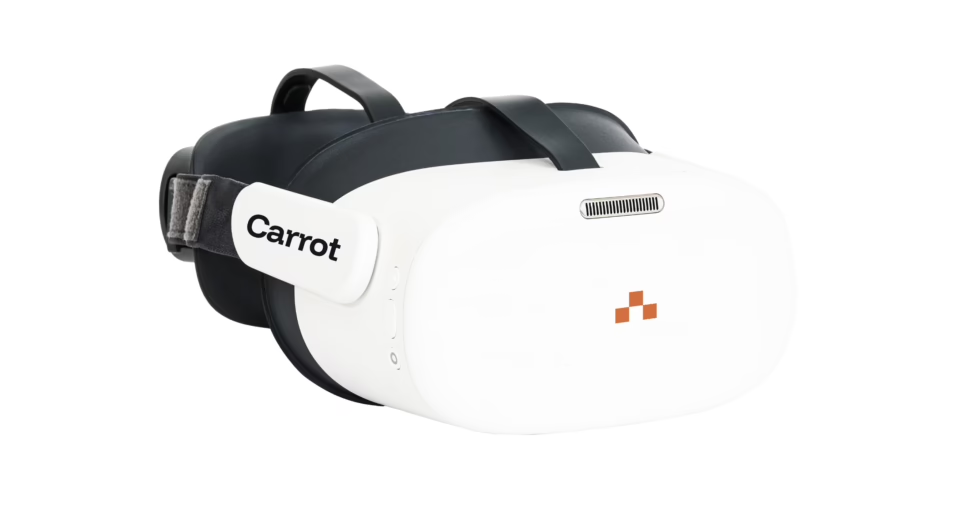
Technology adoption in optometry and ophthalmology is disconcerting but exciting. We’ve gone from traveling peddlers selling glass eye spectacles to lenses with corrected refractive errors made of plastic. And from the irretractable blindness of glaucoma in the early centuries to finding a way to diagnose the disease, followed by surgical and pharmacological care. Are Carrot’s portable and patient-friendly headsets the next evidence-based technological innovation to break barriers and shape the future?
How Does Innovation Work in Optometry/Ophthalmology?
Innovation in optometry and ophthalmology follows the same pathway of inspiration and creation as other groundbreaking technological developments. It begins with identifying a problem and having the vision to find a solution. In between are years, and sometimes decades, of hard work, research, and clinical trials. The final step falls on the shoulders of practitioners, our optometrists and ophthalmologists, to give their seal of approval by embracing the new technology.
Ideas and inventions build on each other, giving rise to new and better devices or improving the old. Before the 1860s, various eye charts littered the walls of optometrists and ophthalmologists—a great idea, but the lack of uniformity made it difficult for eyeglass makers. Dr. Hermann Snellen created the standardized Snellen Chart, which is still used to test visual acuity more than 150 years later.
What Are Some Significant Lessons Learned from Previous Technological Adoptions in These Fields?
Adopting innovations keeps a profession growing and vibrant. Lessons learned from previous technological adoptions demonstrate that innovation:
- Drives economic growth. Adopting new technology makes medical practices more efficient by reducing exam times, enabling them to see more patients, and adding additional staff. Staying on the cusp of change keeps eye care establishments more competitive than those resistant to innovations.
- Improves patient care. When optometrists and ophthalmologists adopt new technologies, such as automated perimetry for early detection of scotomas, patients benefit from earlier diagnosis and treatment of diseases such as glaucoma.
- Succeeds with marketing, education, and training. Advertising makes clients aware of new technology available for their vision health. Medical practices should ensure that training and education are available for both staff and patients.
- Continues to build on previous technology. Optometrists and ophthalmologists could not diagnose glaucoma and other eye conditions without the ophthalmoscope, developed in 1850 by Dr. Hermann von Helmholtz, and the slit lamp, developed in 1911 by Allvar Gullstrand. These innovative tools, which remain essential equipment in optometrists’ and ophthalmologists’ offices, laid the groundwork for developing other technological devices, such as the Optical Coherence Tomography (OCT) machine.
How Is Adopting New Technologies Alongside Older Ones Not Always a Zero-Sum Game?
Adapting new technology alongside older equipment or systems doesn’t mean playing a zero-sum game. Put differently, someone doesn’t have to lose for the other to win. Here are some reasons:
- Previously developed technology can be improved upon. As already seen with the ophthalmoscope and slit lamp, some technology may be enhanced but remain essential tools.
- Technological needs vary in different situations. Cataract surgery performed with phacoemulsification in the United States is too expensive for many people in developing nations, so researchers have developed a more cost-effective technique using small incisions.
- Older technology is still valid. Older technology is welcomed by low and middle-income countries and by providers starting their own businesses.
- Old and new technology can be used to examine the patient. Old technology requires the patient to keep their head in one position for several minutes and may be bulky and uncomfortable for the patient. This can be difficult for patients with medical conditions that make it hard to remain still. Virtual Reality Visual Field technology can decrease patient wait time and make exams faster. Carrot, for example, has been on the market since 2018, when it launched as Virtual Field.

Why Is It Crucial to Quickly Adapt to New Technologies In Optometry and Ophthalmology Today?
It is more important now than ever to adapt to new technologies in optometry and ophthalmology.
- Baby boomers. Despite the United States (US) being warned for years of the upcoming Baby Boomer crunch, the number of ophthalmologists has remained static. The aging population is putting pressure on optometrists and ophthalmologists for cataract and glaucoma treatment, amongst other eye-related diseases. Providers should adopt new technology that increases efficiency, optimizes workflows, and improves the patient experience to ensure continued access to vision care amid growing demand.
- Patient outcomes. Quickly adapting to new technologies improves patient outcomes. Cutting-edge technology that detects early-stage diseases, such as glaucoma and macular degeneration, allows patients to receive treatment before further damage.
- Telemedicine. New virtual reality headsets enable providers to dive into telemedicine and offer remote perimetry testing.
How Has the Adoption of New Technology Changed the Course of Optometry and Ophthalmology Over Time?
The technological development of optometry and ophthalmology has grown steadily throughout the centuries. After the advent of the ophthalmoscope and slit lamp came the phoropter, invented by Henry DeZeng in 1922. The hemispheric bowl to measure visual perimetry, created by Hans Goldmann in 1945, was followed by automated perimetry and the Humphrey Field Analyzer in the 1970s. Pharmacological and surgical options have followed suit, along with research into gene therapy drugs that could offer a cure.
We asked customers to share the most significant innovations. Ophthalmologist Andreas Wolter stated, “The most important innovation for the preservation of vision is, and has been, intravitreal injections, particularly for anti-VEGF.” This technique allows the provider to inject the anti-vascular endothelial growth factor medication into the back of the eye to prevent the growth of abnormal blood vessels. “This amazing benefit comes at the cost of the mounting number of office visits,” affecting “availability and access,” said Wolter. He added that “multifocal lens implants have been the most significant innovation for the improvement of quality of life,” which “may eventually decrease glasses sales and the number of optometry visits.”
Ophthalmologist Reza Moradi identified “light adjustable lenses [that] improve the precision of cataract surgery” as another current and significant technological development.
The industry has also exploded with the advent of virtual reality (VR) and artificial intelligence (AI). VR offers new and innovative ways for perimetry testing, while AI can analyze images to improve diagnostics of eye conditions such as amblyopia, myopia, and strabismus. Researchers are developing algorithm models for practitioners to provide better screening and treatment options.
Adopting new technologies as they innovate and evolve is how optometrists and ophthalmologists can contribute to their profession. It fosters innovation and a commitment to advancing the science of eye care, enabling them to continue providing patients with the best available diagnostic and treatment options. Carrot has taken it a step further by making its visual field perimetry headset affordable as a subscription, helping its clients stay current and integral to the profession.