Stereopsis, or the ability to perceive depth in our three-dimensional world, makes it possible to participate in everyday activities. However, even a minor misalignment can throw off a patient’s depth perception. Poor stereopsis, strabismus, or amblyopia can go unnoticed without regular extraocular motility (EOM) exams, and even then, approximated assessments may keep patients in the dark.
What is Stereopsis and Why is It Important?
Each eye takes in a slightly different image; then the brain processes the disparity to create three-dimensional vision. When both eyes are properly aligned, patients can judge their position in space and interact with objects effectively. Without normal stereopsis, everyday tasks are much more challenging. Activities like walking down the stairs, playing sports, or driving can be dangerous, or even impossible.
Stereopsis is especially important among children, when the brain is still developing visual processing abilities. If a child’s eyes are misaligned and uncorrected, the brain may adapt by suppressing the vision from one eye. Vision problems like amblyopia can develop and, without treatment, may become permanent. This progression can lead to issues with motor skills, reading, and learning, which will naturally have a significant impact on the patient’s quality of life.
How to Test for Stereopsis
Testing for stereopsis typically requires a variety of exams.
To directly evaluate stereopsis, eye care providers use specialized binocular vision tests that measure how well the brain fuses input from both eyes to perceive depth. These tests go beyond muscle function assessments to provide a more accurate picture of a patient’s ability to process three-dimensional information.
One of the most widely used assessments is the Titmus Fly Test (also known as the Stereo Fly Test), which presents polarized 3D images—typically a large fly or geometric circles. Patients wear polarized glasses and are asked to judge depth by reaching for or identifying the raised images, making it a simple and effective screening tool. Another commonly used test is the Randot Stereo Test, which features animals or shapes embedded in a random dot background. These hidden images only appear in 3D when both eyes work together, making it useful for detecting subtle issues with binocular vision.
The TNO Test takes a more refined approach, using red-green glasses and dot patterns to test for fine levels of stereopsis. It’s often preferred for its sensitivity and objectivity. For pediatric patients or those who may not tolerate glasses, the Lang Stereotest offers an alternative that uses lenticular printing to present 3D images without the need for special eyewear.
In addition to these standard tests for stereopsis, an extraocular motility (EOM) test can add additional insights.
A thorough EOM exam measures eye coordination, reveals misalignment, and can help uncover problems with depth perception. If a patient has limited eye movement or unequal strength in their eye muscles, they may experience reduced depth perception. This can occur even if the misalignment is subtle or intermittent.
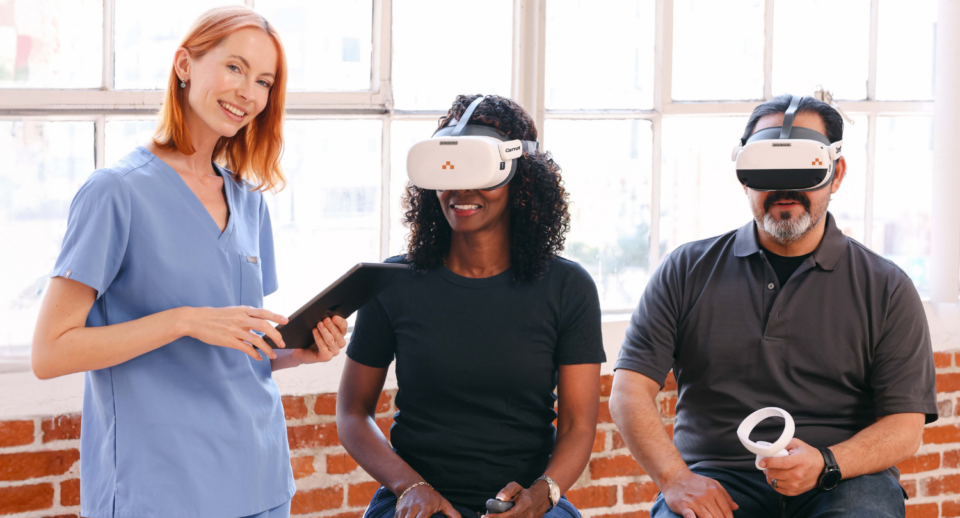
Extraocular motility exams are traditionally conducted with a penlight or other object. Patients are asked to follow the stimulus with their eyes while providers record eye-tracking data. This method is a quick and straightforward way to measure muscle function, but it lacks objective accuracy. Carrot’s extraocular motility tests use real-time eye-tracking technology and video to measure patients’ actual eye movements and collect data for a more thorough review.