Practice Overview
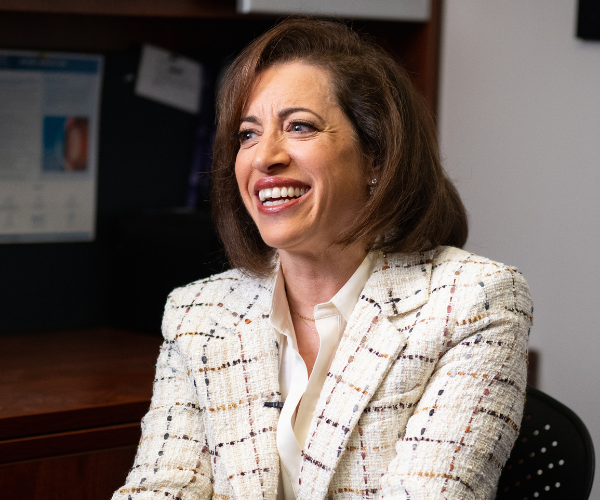
Akler Eye Center, located in the Detroit area, provides comprehensive ophthalmology services to a diverse patient population. Led by board-certified ophthalmologist Dr. Michelle Akler, the practice provides comprehensive eye care from routine vision exams to cataract surgery, glaucoma management, and retinal disease management.
“We see a full range of patients from about age five all the way through adulthood,” explained Dr. Akler. “My focus is cataract surgery and refractive surgery, but we also take care of a lot of glaucoma patients and medical retina conditions.”
On a typical day, the clinic sees 40 to 45 patients, many of whom are elderly or have mobility challenges.
Delivering high-quality care for this population requires diagnostic tools that are both accurate and easy for patients to complete.
The Challenge: Aging Equipment and Inefficient Visual Field Testing
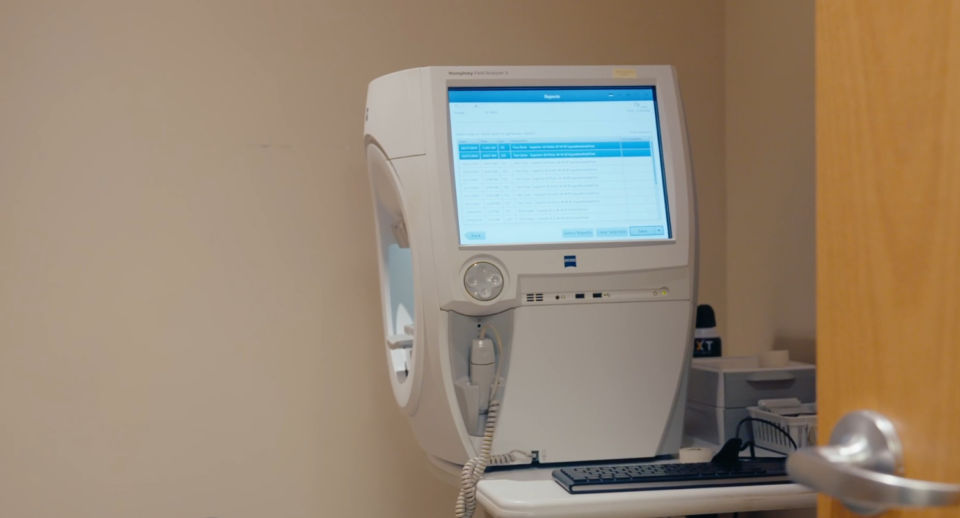
Like many ophthalmology practices, Akler Eye Center previously relied on a traditional tabletop visual field device. Over time, however, that system became unreliable and difficult for patients to use.
“We had been using a refurbished Humphrey visual field for years,” said Dr. Akler. “Eventually, it became extremely unreliable. There were clinic days where we couldn’t run the test at all.”
The impact on patient care was significant.
When any of our equipment stops working in the middle of the clinic, it suddenly impairs our ability to take care of patients,” Dr. Akler explained. “A lot of our patients are elderly and need family members to bring them in. Having to tell them to come back another day was unacceptable.”
Even when the device was working, the testing process was difficult.
Technicians had to carefully position patients in a chin rest and monitor them closely throughout the exam.
“It’s difficult for some of our senior patients to keep their head in the chin rest and maintain fixation,” said Barbara, a refractive coordinator at Akler Eye Center. “We’d often have fixation losses and have to keep adjusting them during the test.”
The process slowed down clinic flow and created bottlenecks throughout the day.
“Our workflow was more congested because it took longer to get patients situated in the old visual field,” said Roxanna, a clinical coordinator who has worked with Dr. Akler for more than 20 years. “We found ourselves running behind quite frequently.”
The Solution: Switching to the Carrot Visual Diagnostic Platform
When the existing visual field system became unsustainable, Dr. Akler began researching alternatives.
She first heard about Carrot (formerly Virtual Field) through ophthalmology professional groups.
“I had heard about Carrot online in a number of ophthalmology chat groups,” she explains. “It was…the forerunner in this space. We ordered one for the free trial and said, ‘Let’s see if we like it.’ And it was all good from there. We obviously didn’t send it back.”
Implementation proved remarkably simple.
“Setup took about 20 minutes,” said Barbara. “The learning curve was about 10 minutes.”
Faster Testing and Improved Clinic Efficiency
The most immediate impact was dramatically faster testing times
With Carrot, the visual field takes about three to six minutes for both eyes,” said Barbara. “With the old tabletop visual field, it could take eight to twenty minutes.”
Dr. Akler estimates that the test itself is nearly twice as fast as traditional platforms.
“The test-taking time is almost half of what it took with a traditional Humphrey visual field,” she said. “That means we can run more tests in a day.”
Shorter testing times also eliminated scheduling delays.
“In the past, we could be delayed anywhere from five to fifteen minutes just getting patients positioned,” said Roxanna. “Now the wait is usually less than five minutes.”
Technicians can also multitask while tests run.
“The techs don’t have to sit with the patient anymore,” said Dr. Akler. “They’ll start working up another patient or inputting data into the computer.”
Barbagra agreed, adding, “I can run the visual field and simultaneously work up another patient. It frees up a lot of time.”
A Dramatically Better Patient Experience
The new platform also transformed how patients experience visual field testing, which was critical, as many patients previously dreaded the exam.
“Patients would come in for glaucoma testing and say, ‘Ugh, this test again,’” Roxanna said.
With Carrot, that reaction has changed.
Patients are much more comfortable,” Roxanna explains. “You’re not forcing them into a big machine or repositioning them constantly.”
Comfort improvements are especially important for elderly patients.
“They’re not bending or hunched over anymore,” said Barbara. “They’re much more relaxed during the test.”
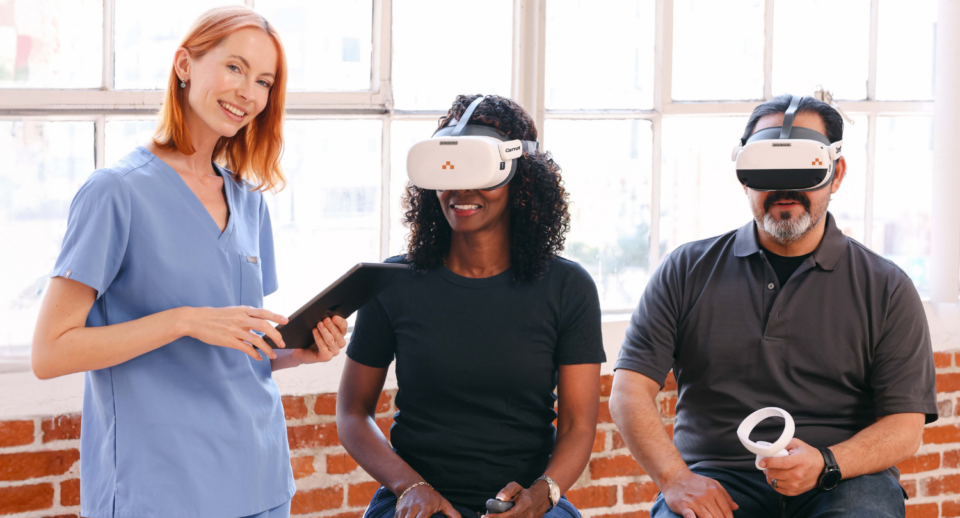
The Carrot headset format also allows the clinic to bring testing to the patient, rather than moving patients between rooms.
“Being able to bring the headset to the patient instead of moving them into a testing room saves many minutes every day,” Dr. Akler said.
This flexibility is particularly valuable for patients with mobility challenges.
“We had a patient who was 102 years old complete the visual field in about seven minutes,” Barbara recalls. “It’s awesome for our elderly patients.”
Multilingual Testing Improves Accuracy and Accessibility
Akler Eye Center serves a highly diverse community with many non-English speakers.
Previously, technicians often had to rely on interpreters or smartphone translation tools to explain the test.
“Sometimes patients would forget to bring someone who could translate,” Roxanna says. “Then we’d be using a phone translator, which isn’t always accurate.”
Carrot’s multilingual functionality eliminated that barrier.
We have a large Arabic patient population,” Barbara said. “Now we can set the test to Arabic and the patient understands the instructions directly.”
Roxanna describes the impact on patient experience: “We had an Arabic-speaking patient try it, and they were so happy they could understand what the machine was saying without relying on a family member.”
This feature not only improves patient satisfaction but also increases test reliability.
Better Diagnostics and Life-Changing Outcomes
In one remarkable case, the test’s improved reliability led to a life-saving diagnosis.
“We had a Spanish-speaking patient who came in with vision loss in one eye,” Dr. Akler explained.
The clinical exam appeared normal, but the Carrot visual field test, administered in Spanish, revealed a serious neurological issue.
I knew just from looking at the test that she had a brain tumor,” Dr. Akler said.
The patient received urgent imaging and underwent surgery within a week.
“I don’t know if the result would have been the same if she couldn’t have taken the test in her native language,” Dr. Akler adds. “Her diagnosis may have been delayed.”
Looking Ahead
For Akler Eye Center, switching to Carrot fundamentally improved the way the clinic delivers care. She sees the platform as the future of visual field testing.
For me, it’s a no-brainer,” she says. “It’s more efficient, a way better patient experience, very reasonably priced, and the results are very similar to what we’re used to.”
Her conclusion is simple:
“I would never go back to a traditional tabletop visual field.”