
Free Reference Guide · Printable PDF · Instant Access
Every Carrot exam, mapped to the code you bill it under.
The 2026 CPT and ICD-10-CM reference for visual field and functional vision testing — codes, estimated Medicare national averages, the glaucoma diagnoses that support medical necessity, and where the line sits between billable testing and patient-pay. Built for the person who has to defend the claim.
- Five billable CPT codes with 2026 estimates
- Every exam Carrot runs, grouped and coded
- Glaucoma ICD-10 rows per MAC guidance
- Three revenue pathways, including patient-pay
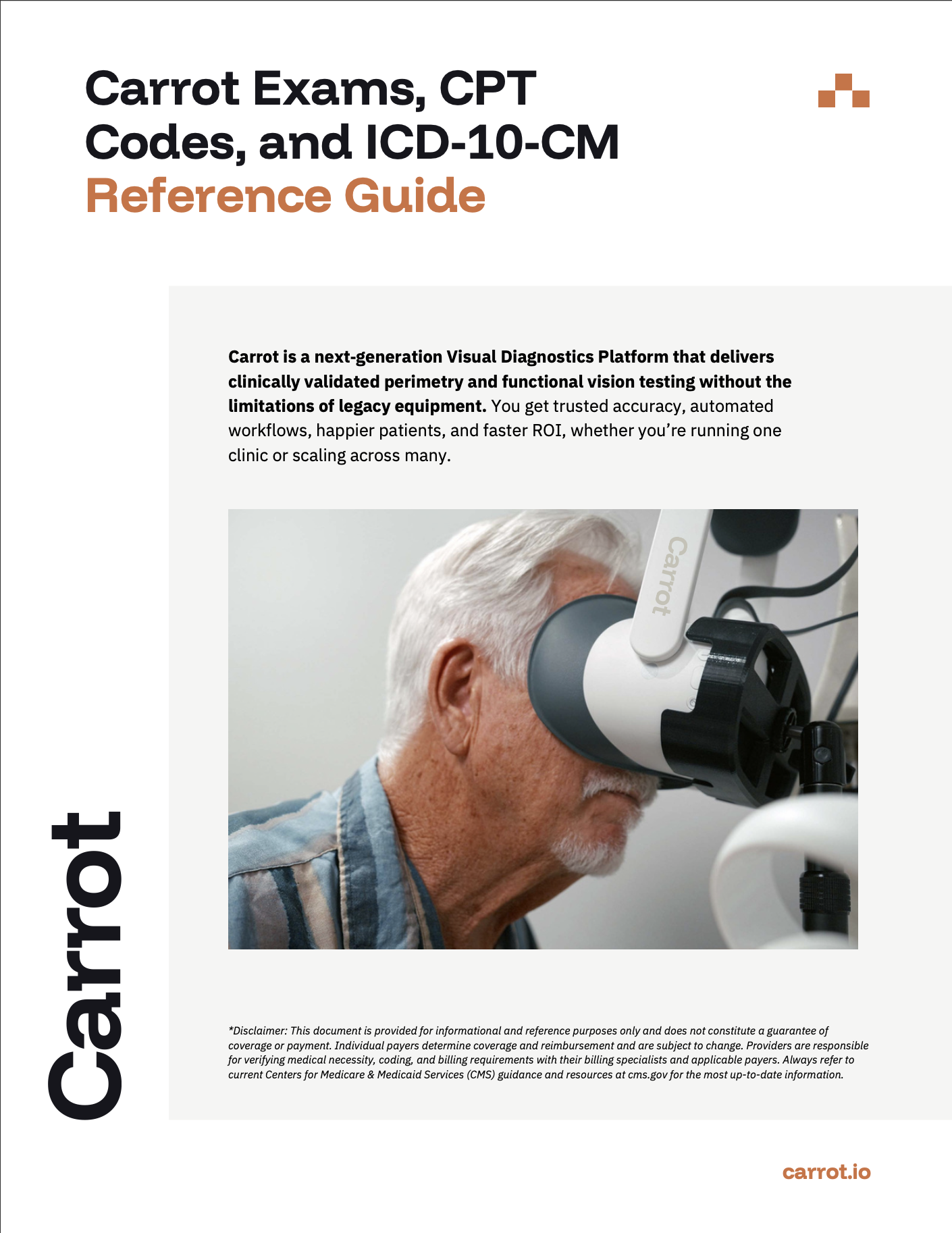
Keep the PDF on the billing desk, or send it to your coder before the next claim goes out.
Instant access
Get your free guide
Opens immediately after you submit — nothing to wait for.
5M+
exams completed
2.5k+
clinics nationwide
15
validated tests
5+
CPT-supported codes
Why this matters
The test gets run. The coding is where it goes wrong.
A field is performed and coded limited when the extent supported extended. A screening gets billed as diagnostic with no documented medical necessity. An Esterman for a DMV form goes out as a claim instead of a clearly communicated patient-pay service. None of it looks like a problem on the day — it shows up as denials, write-offs and awkward conversations weeks later.
Denials
Claims that fail on documentation rather than on the clinical decision behind them.
Undercoding
Extended testing performed and reported at the limited or intermediate level.
Inconsistency
Two techs, two sites, two different codes for the same test on the same kind of patient.
Patient friction
Non-covered testing that wasn't flagged as non-covered until the statement arrived.
Inside the guide
The five codes, and what Medicare estimates for each
Carrot supports standard visual field and related diagnostic testing workflows aligned with commonly billed CPT codes, so testing fits the reimbursement pathways your practice already runs.
| CPT Code | Description | 2026 Medicare National Avg. Payment (Est.) |
|---|---|---|
| 92081 | Visual field exam – limited | ~$25–$30 |
| 92082 | Visual field exam – intermediate | ~$40–$50 |
| 92083 | Visual field exam – extended | ~$60–$75 |
| 92283 | Color vision exam – extended (coming soon) | ~$35–$55 |
| 95919 | Quantitative pupillometry | ~$10–$20 |
Code selection is based on the extent of testing performed and the clinical indication. Figures are estimates for a non-facility (office) setting and are subject to geographic variation and payer policy. D-15 color vision availability coming soon; billing under 92283 may apply when clinically appropriate and consistent with payer requirements.
What Carrot runs
One device, grouped the way you'd look it up
Clinically relevant visual field and functional vision tests from a single platform — supporting glaucoma management, neuro-ophthalmic evaluation, ptosis assessment and pupil function. The guide pairs each group with the codes commonly used to document and bill it.
Automated perimetry and visual fields
- 24-2, 24-2C, 10-2, 30-224-2C adds central test points, improving detection of early central defects — useful in glaucoma, where damage may occur closer to fixation.
Color vision
- Ishihara color platesTypically a screening tool; not generally billed as a standalone reimbursable service.
- D-15 color visionComing soon from Carrot. May support billing under 92283 when clinically appropriate.
Screening / suprathreshold fields
- Foveal Threshold, C-40 Screening, N-30 ScreeningSuprathreshold screening protocols.
- Superior 36Ptosis screening, suprathreshold.
Binocular vision and pupils
- Extraocular motility (EOM)Pro
- PupillometryQuantitative pupillometry, commonly documented under 95919. Pro subscription.
Specialty visual fields
- Esterman Driving, Full-Field 120Esterman is frequently a non-covered, patient-pay service when performed for licensing.
- Kinetic visual field (Goldmann-style)Pro subscription.
Clinical note from the guide
- Severe-stage glaucomaConsider 10-2 rather than 24-2 to better assess central visual function.
Medical necessity
The glaucoma diagnoses that support a field
Visual field testing is most commonly performed in the evaluation and management of glaucoma and glaucoma-suspect patients. These are the conditions that most often support medical necessity under current Medicare Administrative Contractor guidance.
| Clinical Diagnosis | ICD-10-CM Code(s) | Common Use Case for Visual Field Testing | Supported CPT(s) |
|---|---|---|---|
| Ocular hypertension | H40.051–H40.053 | Baseline and follow-up visual field testing for ocular hypertension | 92083 |
| Open angle with borderline findings, LOW risk | H40.011–H40.013 | Baseline and follow-up visual field testing for glaucoma suspects | 92083 |
| Open angle with borderline findings, HIGH risk | H40.021–H40.023 | Baseline and follow-up visual field testing for glaucoma suspects | 92083 |
| Primary open-angle glaucoma | H40.11xx | Baseline and follow-up visual field testing for confirmed glaucoma | 92083 |
This is a focused reference, not an exhaustive list of covered diagnoses. The full list of more than 2,800 ICD-10-CM codes supported by CMS for visual field testing — optic neuropathies, eyelid conditions, retinal disease and secondary glaucomas — is available on request, and the guide tells you how to ask for it.
Reimbursement and revenue
Three ways the testing pays, and the line between them
Most coding trouble comes from treating these three as one. The guide keeps them separate and gives you the language for each.
Diagnostic testing, insurance-billed
Exams billed when medically necessary to support diagnosis, management or monitoring of ocular and neurologic conditions — visual field testing and other diagnostic evaluations aligned with the CPT codes above.
Turns on: documented medical necessity
Testing inside a comprehensive exam
Visual field testing is often folded into clinical workflow. But performed as routine screening, or without documented medical necessity, it is generally not reimbursable by insurance.
Watch for: screening billed as diagnostic
Non-covered and patient-pay
Offered out-of-pocket when not covered and performed outside standard comprehensive exam services:
- Driver's license or occupational field testing (e.g. Esterman)
- Diagnostic testing not meeting medical necessity criteria
- Patient-requested testing beyond routine care
Required: clearly communicated as non-covered and optional
Who it's for
Written for everyone who touches the claim
Billers and coders
One page that pairs the exam performed with the code commonly used to report it, plus the documentation that has to sit behind it.
Optometrists and ophthalmologists
Which field test the clinical picture calls for, and what has to be in the chart for it to hold up on review.
Owners and operations leaders
What the diagnostic testing you already perform is estimated to return, and where revenue is being left uncaptured.
Practice administrators
A shared reference so every site codes the same test the same way, and patient-pay services are flagged before the test, not after.
Supported by CMS for visual field testing
2,800+
ICD-10-CM codes, not just the glaucoma ones
Optic neuropathies, eyelid conditions, retinal disease, secondary glaucomas. The guide covers the diagnoses you'll see most, and the full list is available on request.
About Carrot
More than a visual field analyzer.
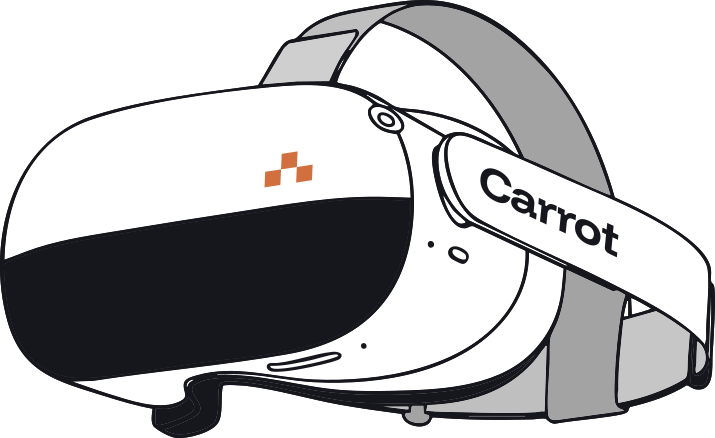
Carrot is an end-to-end Visual Diagnostics Platform that delivers clinically validated perimetry and functional vision testing through a portable, automated system — helping practices run more tests, improve patient experience and scale without adding rooms or staff. Its lightweight design makes testing easier for patients who struggle with traditional tabletop equipment, including wheelchair users and those with mobility limitations. We invented VR perimetry in 2018, and more virtual visual exams have been run on Carrot than all competitors combined.
15
validated tests
5+
CPT-supported codes
2.5k+
clinics nationwide
Join 2.5k+ practices running smarter exams
“Now with Carrot, we can offer Esterman tests. For patients who need a DMV form, we can perform that test and bill for it.”
“I can run the visual field and simultaneously work up another patient. It frees up a lot of time.”
“Carrot is saving us about 10 minutes per patient encounter, which really adds up when you're seeing 100 patients a day.”
“Onboarding with Carrot is one of the easiest things we've done. New techs are literally able to use it the same day.”
Before you download
Questions people ask
What do I get, exactly?
Are the payment figures guaranteed?
Do I have to be a Carrot customer?
Can I get the full 2,800-code list?
Is this coding or clinical advice?
Is this going to trigger a sales call?
Put the codes on the desk where the claims get built.
The exams, the five CPT codes, the 2026 estimates, the glaucoma ICD-10 rows and the three reimbursement pathways — in one printable reference.
Get My Free GuideFree · opens instantly · PDF download included